Your favorite restaurant recipes, recreated at home — tested and easy to follow.


Red Ranch is one of the great misnamed condiments in fast food. There is no buttermilk in it, no mayonnaise, no sour cream, no dill, no chives — nothing that would make a person call it ranch. Arby’s publishes the ingredient list, and it reads like a bottle of Catalina dressing: sweetener first, soybean oil second, cider vinegar third, then tomato paste, distilled vinegar, water, salt, paprika, spice, and beet juice for color. That’s a sweet-sour emulsified dressing, not a barbecue sauce and definitely not a ranch.
Which is why so many copycat recipes miss. Nearly all of them start with a half cup of ketchup and a slug of Worcestershire, simmer it down, and call it done. That gets you a decent burger sauce, but Worcestershire isn’t anywhere on the real label, and ketchup’s own clove-and-onion background pulls the flavor toward barbecue. The actual sauce is brighter, sweeter, and slicker on the tongue — the oil is what makes it cling to hot roast beef the way it does on a Beef ‘n Cheddar, which is the sandwich the sauce was essentially designed around back in the late seventies.
So I built this one from the label outward: tomato paste for clean tomato depth, apple cider vinegar as the dominant acid, real sugar, sweet paprika for warmth and color, and a proper oil emulsion whisked in off the heat. It takes about ten minutes on the stove and an hour in the fridge. If you like sauces reverse-engineered this way rather than guessed at, my Copycat Swiss Chalet Sauce Recipe came together with the same approach.
Why This Copycat Works
- Follows the published ingredient order — sweetener, oil, cider vinegar, tomato paste — instead of the ketchup-and-Worcestershire formula everyone repeats.
- Whisking the oil in off the heat gives you the glossy, clingy texture that makes it behave like the restaurant sauce on a hot sandwich.
- About 10 minutes of stove time, plus an hour to chill.
- Hardest part: getting the emulsion to hold. There’s a one-ingredient fix below if yours splits.
Key Ingredients & Substitutions
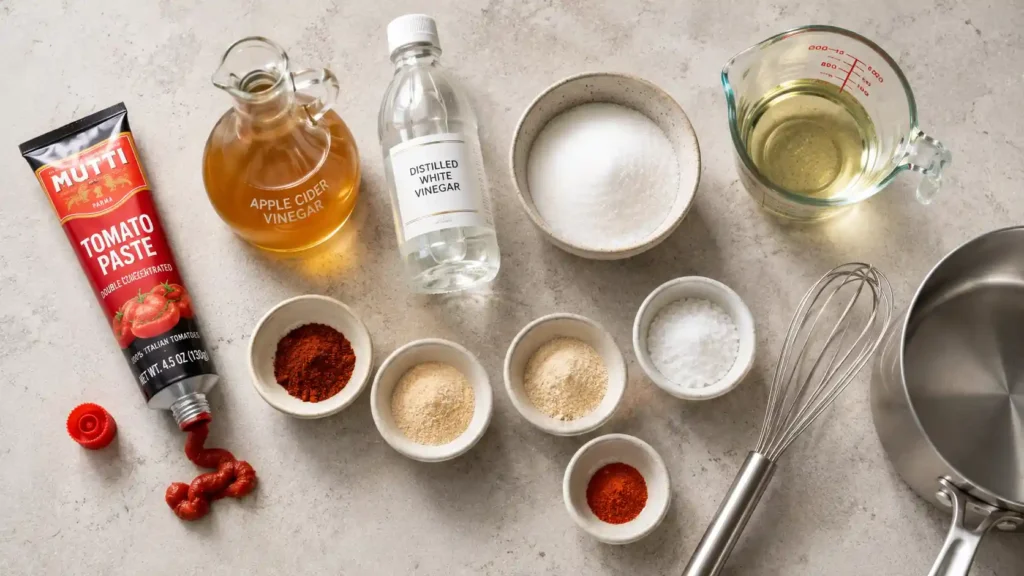
Tomato paste (the base). Paste gives concentrated tomato flavor and the deep red without dragging in ketchup’s added vinegar, onion, and spice. If you only have ketchup, use 1/3 cup in place of the paste and cut the sugar by two-thirds and the water entirely — workable, but noticeably more barbecue-leaning. Tomato paste in a tube is worth buying if you make sauces often, since you’ll only need a few tablespoons at a time.
Apple cider vinegar (the primary acid). The real label names a corn-cider vinegar high on the list, and cider vinegar is what gets you closest at home — it has a rounder, faintly fruity sharpness that plain white vinegar can’t fake. White vinegar alone works but tastes flatter and more aggressive. I use a small amount of white vinegar alongside it because the original lists both.
Sugar (structure, not just sweetness). The real sauce leads with a sweetener, so don’t be shy here. Granulated sugar keeps the color bright; brown sugar works and pushes it darker and more molasses-y, which reads more like barbecue sauce than Red Ranch.
Neutral oil (texture and cling). This is the ingredient copycats skip and it changes everything. Oil is second on the actual ingredient list, and it’s why the sauce coats meat instead of running off it. Use canola, sunflower, or another neutral oil. Olive oil works but adds a peppery flavor that fights the sauce.
Sweet paprika. Paprika is named specifically on the label. Use plain sweet paprika, not smoked — smoked paprika is the single fastest way to make this taste like barbecue sauce instead of Red Ranch.
Onion and garlic powder. Both appear as dehydrated onion and garlic on the real list, so powders are correct here rather than fresh. Onion is listed ahead of garlic, and that ratio matters: onion should be the louder of the two.
Cayenne (optional). There’s a faint background warmth in the restaurant version. An eighth of a teaspoon gets you there. Skip it entirely if you’re feeding kids.
Xanthan gum (optional but useful). The real sauce uses xanthan gum and propylene glycol alginate to hold the emulsion, which is why a packet never separates. A pinch of xanthan gum does the same job at home and is sold in the baking or gluten-free aisle of most supermarkets. Without it, your sauce will separate in the fridge — harmless, just shake it.
How to Make Arby’s Red Ranch at Home
You’ll warm the tomato paste, vinegars, sugar, water, and spices together just long enough to dissolve the sugar and bloom the paprika, then pull the pan off the heat and whisk in the oil in a thin stream to build an emulsion. Stove time is about five minutes; total active work is closer to ten. Warming first matters because sugar won’t fully dissolve in cold vinegar, and undissolved sugar is the gritty texture people complain about in no-cook versions.
Step 1: Combine Everything but the Oil
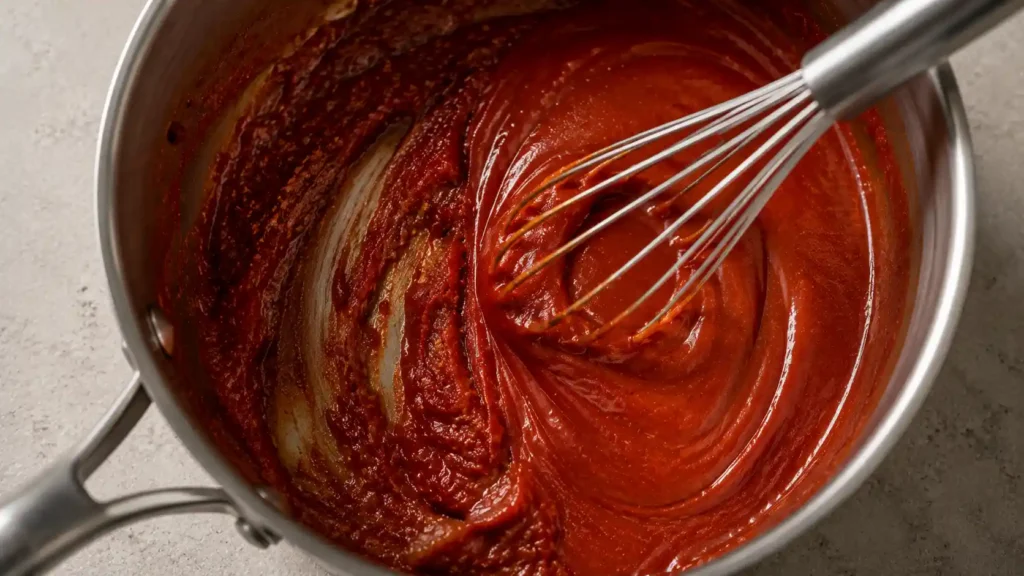
In a 1-quart saucepan, whisk together 3 tablespoons tomato paste, 3 tablespoons apple cider vinegar, 3 tablespoons granulated sugar, 2 tablespoons water, 1 1/2 teaspoons distilled white vinegar, 3/4 teaspoon sweet paprika, 1/2 teaspoon onion powder, 1/2 teaspoon kosher salt, 1/4 teaspoon garlic powder, and 1/8 teaspoon cayenne if using. Whisk until the paste is fully broken up and the mixture is a smooth, uniform red with no dark lumps clinging to the sides. A small saucepan matters here — in a wide pan this small volume scorches before it warms through.
Step 2: Warm Until the Sugar Dissolves
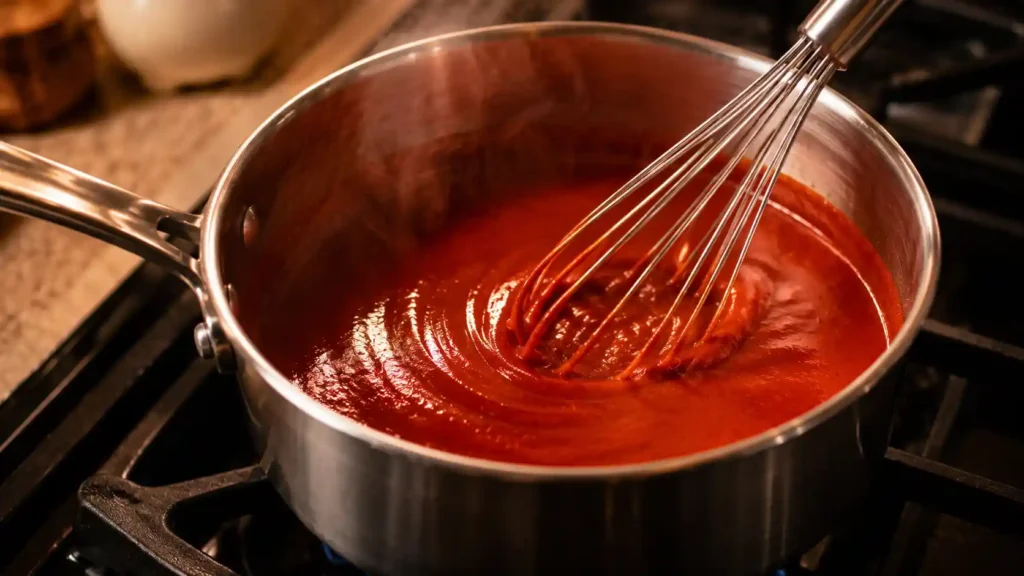
Set the pan over medium-low heat and whisk constantly for 3 to 4 minutes. You’re looking for steam rising and the surface turning glossy — roughly 160 to 170°F if you’re checking. Do not let it simmer or bubble; boiling drives off the cider vinegar’s aroma, which is a big part of the flavor you’re chasing. To test, rub a drop between your finger and thumb once it’s cooled a second: if it feels sandy, keep whisking. Smooth means the sugar is dissolved.
Step 3: Whisk In the Oil Off the Heat
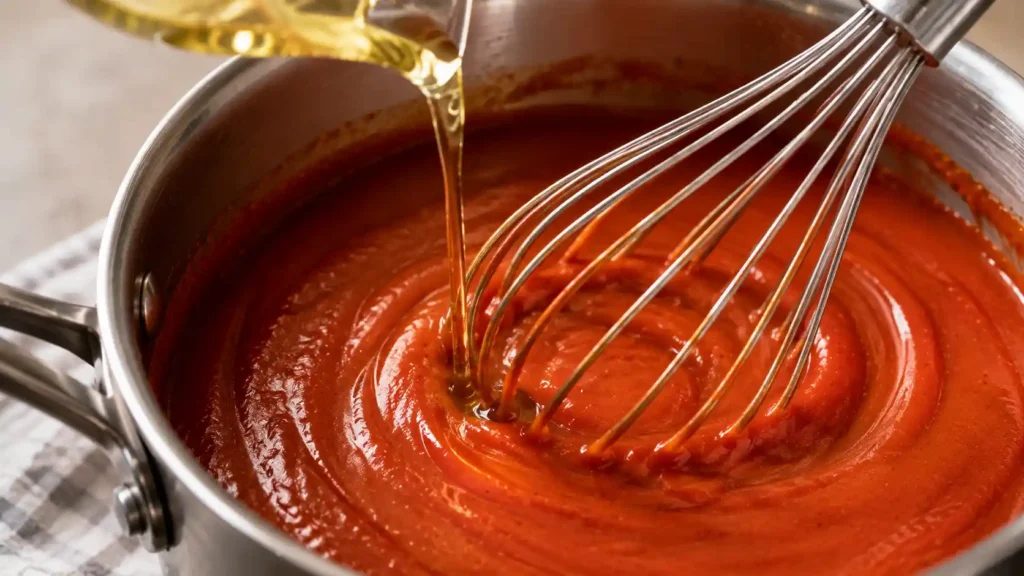
Take the pan off the burner and let it sit for 60 seconds. Then, whisking constantly, pour in 1/4 cup neutral oil in a thin, steady stream — the thinner the stream, the better the emulsion. This should take 30 to 45 seconds, not a single dump. When it’s done the sauce will look opaque, glossy, and slightly lighter red than it did going in, and it will coat the back of a spoon without running straight off.
Chef’s Note: If you want an emulsion that never breaks, sprinkle 1/8 teaspoon of xanthan gum over the warm base before adding the oil and whisk hard for 20 seconds. Add it while whisking, never in a lump — xanthan clumps instantly on contact and those clumps will not dissolve later. An immersion blender makes this foolproof.
Step 4: Cool and Chill
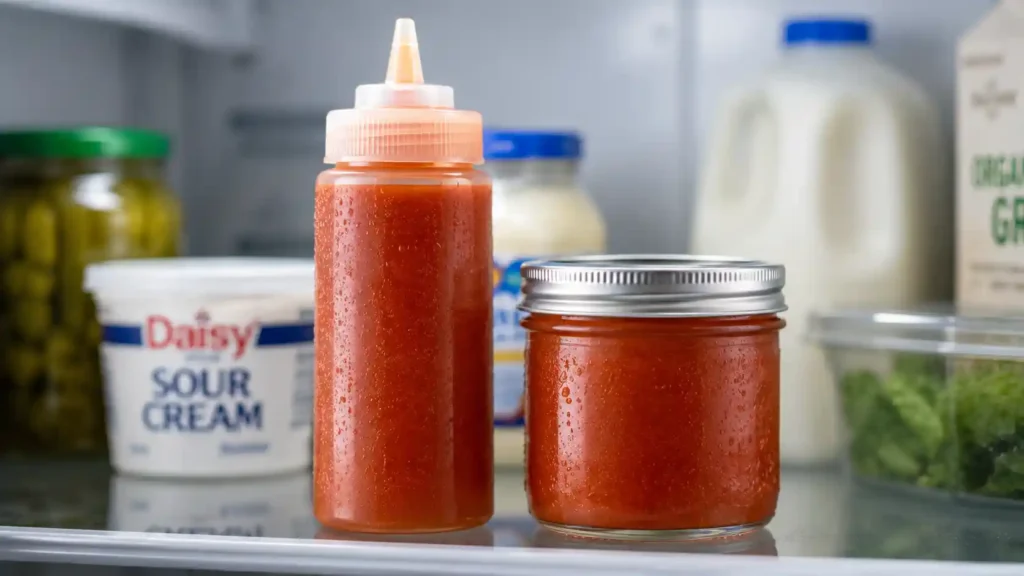
Let the sauce cool in the pan for about 15 minutes, then transfer to a jar or squeeze bottle and refrigerate at least 1 hour before using. It thickens noticeably as it chills — if it looks thin while warm, that’s expected. Taste it cold, not hot; warm sauce always reads sweeter than it will on a sandwich.
Red Ranch Isn’t Ranch, and It Isn’t Barbecue Sauce Either
Once you’ve seen the ingredient list, the category question answers itself. There is no dairy, no egg, and no mayonnaise anywhere in Red Ranch — the “ranch” in the name is marketing, not a description. What it actually resembles is a French or Catalina-style dressing: sweetener, oil, vinegar, tomato, paprika, and a little onion and garlic, held together with a gum. That’s why some people describe it as tasting like Catalina dressing on a roast beef sandwich, and they’re not wrong.
That also explains the two most common ways homemade versions go sideways. Adding Worcestershire pushes it toward Arby’s own signature sauce, which is a different product entirely. Adding smoked paprika or liquid smoke pushes it toward barbecue. Neither belongs.
Red Ranch is a dressing wearing a sauce’s name. Treat it like one and it comes out right.
Red Ranch vs. Arby’s Sauce vs. Horsey Sauce
These three get confused constantly, and the published ingredient lists make the differences clear. Arby’s Sauce leads with water and corn syrup over tomato paste and distilled vinegar with a starch thickener — thinner, tangier, less rich. Red Ranch leads with sweetener and oil, uses cider vinegar, and adds paprika and beet juice — sweeter, glossier, more clinging. Horsey Sauce is the outlier: a creamy horseradish spread with an entirely different job.
| Red Ranch | Arby’s Sauce | Horsey Sauce | |
|---|---|---|---|
| Style | Sweet-tangy dressing | Thin tangy tomato sauce | Creamy horseradish |
| Dominant note | Sweet, cider-vinegar bright | Sharp vinegar, tomato | Horseradish heat |
| Texture | Glossy, clings to meat | Runny, pourable | Thick, spreadable |
| Contains dairy or egg | No | No | Yes, it’s cream-based |
| Classic pairing | Beef ‘n Cheddar | Roast beef, curly fries | Roast beef |
Can You Buy Red Ranch in a Bottle?
Not currently. Arby’s sells some of its sauces bottled through grocery retailers, but Red Ranch has not been among them — it stays a restaurant item, which is exactly why this recipe gets searched for so often. Availability changes, so it’s worth a glance at the condiment aisle, but don’t count on it.
Two shortcuts if you need something tonight. A bottled Catalina or French dressing is genuinely in the neighborhood — thin it slightly and add a pinch of paprika and onion powder and it’ll pass on a sandwich. And if you’re ordering out, be aware Red Ranch isn’t automatically added on every menu item at every location, so ask for it by name if you want it.
When Your Batch Splits, Grits, or Tastes Flat
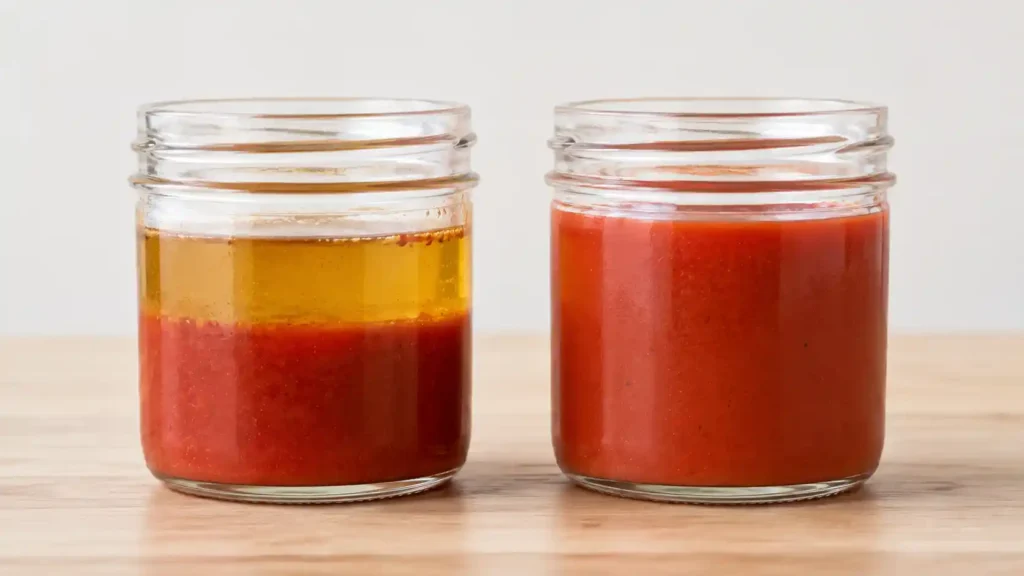
It separated in the fridge with a layer of oil on top. Normal without a stabilizer. Shake or whisk it back together, or make the next batch with a pinch of xanthan gum.
It’s gritty. The sugar never dissolved. Return it to low heat, whisk 2 more minutes, and check by rubbing a cooled drop between your fingers.
It tastes like barbecue sauce. You used smoked paprika, brown sugar, ketchup, or Worcestershire — or several of them. Switch to sweet paprika and white sugar and rebuild on tomato paste.
It’s too sharp. Too much vinegar for the sugar you used. Add sugar 1 teaspoon at a time over low heat until balanced, since sugar won’t dissolve into a cold sauce.
It’s flat and one-note sweet. Usually not enough salt, occasionally not enough onion powder. Add 1/8 teaspoon salt, taste cold, repeat once if needed.
It’s too thick after chilling. Whisk in water a teaspoon at a time. It should ribbon off a spoon, not plop.
Common mistake: Boiling the base. A hard simmer cooks off the cider vinegar’s aroma and caramelizes the sugar, which turns the sauce brownish and slightly bitter. Keep it at a steam, never at a bubble, and pull it the moment the sugar is gone.
Calories, Carbs, and a Lower-Sugar Version
Published nutrition data for the restaurant sauce puts a half-ounce serving at roughly 70 calories with about 5 grams of carbohydrate, most of that sugar. My homemade version lands in a similar range per tablespoon, since the calories come from the same two places: oil and sugar.
To bring both down, the levers are straightforward. Cut the oil to 2 tablespoons and add 1 extra tablespoon of water — you lose some of the cling, so this is the version to use as a dip rather than a sandwich spread. For the sugar, replace half with a granulated sugar substitute that dissolves in liquid, keeping at least half real sugar so the texture doesn’t turn thin and watery. The sauce is naturally dairy-free and egg-free either way, which makes it an easy condiment to keep around when you’re cooking for mixed dietary needs.
Building the Beef ‘n Cheddar at Home
The sauce exists for one sandwich in particular, so start there: thin-sliced deli roast beef warmed in a splash of beef broth so it stays juicy, a warm cheddar cheese sauce, Red Ranch, and a soft onion roll. Toast the roll cut-side down in a dry skillet for 60 to 90 seconds until it’s just golden — a warm roll is most of the difference between a home sandwich and a sad one.
Beyond that, Red Ranch is good on burgers, in a wrap, over crinkle fries or curly fries, and stirred into a slaw for a sweet-tangy dressing. It’s excellent on crispy chicken wings if you want something sweet and glossy instead of buffalo, and it holds its own on a snack board next to homemade Triscuit-style crackers and sharp cheddar. If you’d rather have a creamy sandwich spread in the fridge alongside it, my Tim Hortons chipotle sauce covers that end of the spectrum.
Storage, Scaling, and the Gear That Matters
Cool the sauce completely before sealing it, or condensation will thin it and shorten its life. In an airtight jar in the fridge it holds about two weeks — vinegar and sugar are both preservatives, which is why it keeps far longer than a mayonnaise-based sauce. It freezes acceptably for a few months in a small container, though the emulsion breaks on thawing and needs a hard whisk to come back. Frankly, it’s fast enough to make that I’d rather make a fresh batch.
Double or triple it with no changes to method, but keep the pan proportional — a small volume in a wide pan is how batches scorch.
As for equipment, a 1-quart saucepan and a small balloon whisk are all you truly need, and inexpensive ones work perfectly. Two things do earn their place. An immersion blender turns the oil emulsion from a technique into a non-event, especially if you’re adding xanthan gum. And a squeeze bottle is genuinely worth having for this one, because Red Ranch is thin enough to squeeze and you’ll want a controlled line across a sandwich rather than a spoonful in the middle. A thermometer is optional; the visual cue of steam without bubbles is reliable enough.
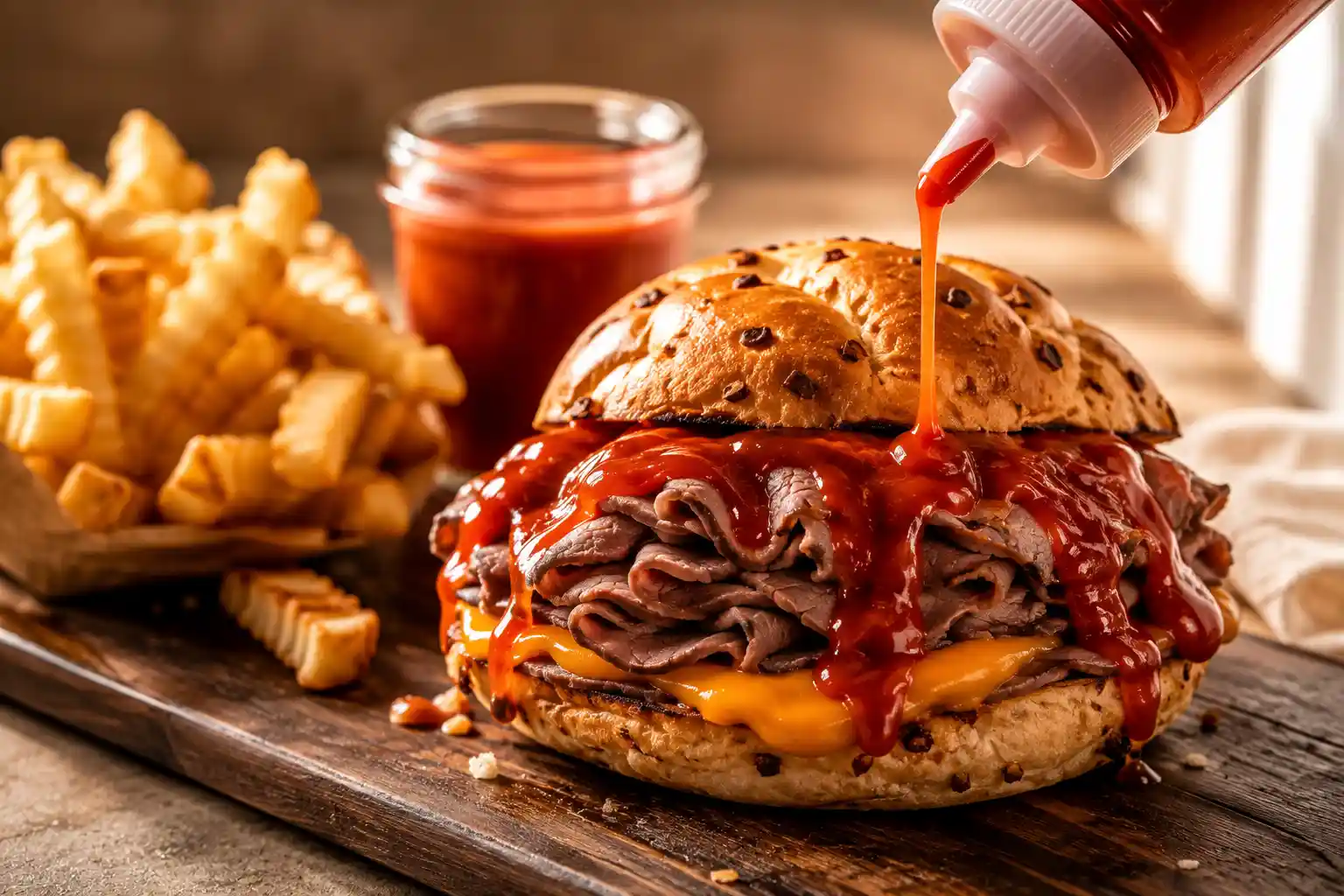

Copycat Arby’s Red Ranch Sauce
A sweet, tangy, glossy sandwich sauce built from Arby’s published ingredient list rather than the usual ketchup-and-Worcestershire shortcut. Tomato paste, cider vinegar, sugar, and paprika, emulsified with oil so it clings to hot roast beef the way the restaurant version does. Ten minutes on the stove and an hour in the fridge.
Ingredients
Equipment
Method
- In a 1-quart saucepan, whisk together the tomato paste, apple cider vinegar, sugar, water, white vinegar, paprika, onion powder, salt, garlic powder, and cayenne until completely smooth with no lumps of paste.
- Set over medium-low heat and whisk constantly for 3 to 4 minutes, until the mixture steams and turns glossy. Do not let it bubble. Test a cooled drop between your fingers — it should feel smooth, not sandy.
- If using xanthan gum, sprinkle it over the surface while whisking hard, and whisk 20 seconds until fully incorporated.
- Remove the pan from the heat and rest 1 minute. Whisking constantly, add the oil in a thin steady stream over 30 to 45 seconds. The sauce should turn opaque and glossy and coat the back of a spoon.
- Cool 15 minutes, transfer to a jar or squeeze bottle, and refrigerate at least 1 hour. It thickens as it chills. Taste and adjust cold, not warm.
Video
Notes
Keeps about two weeks in an airtight jar in the fridge. Cool completely before sealing.
Without xanthan gum the sauce will separate in the fridge — shake or whisk before using.
Use sweet paprika and white sugar. Smoked paprika, brown sugar, ketchup, or Worcestershire will push this toward barbecue sauce.
No tomato paste? Use 1/3 cup ketchup, cut the sugar to 1 tablespoon, and omit the water.
For the lower-sugar and lower-fat adjustments, see the section covered above.
Frequently Asked Questions
What are the actual Arby’s Red Ranch sauce ingredients?
Arby’s publishes the list, and it starts with high fructose corn syrup, soybean oil, corn-cider vinegar, tomato paste, distilled vinegar, water, and salt, followed by paprika, spice, beet juice for color, dehydrated onion, natural flavor, xanthan gum, propylene glycol alginate, and dehydrated garlic. Notice what is not there: no ketchup, no Worcestershire sauce, no dairy, and no mayonnaise. That ordering is why this copycat leads with sugar, oil, cider vinegar, and tomato paste instead of a ketchup base.
Is Red Ranch actually ranch dressing?
No, and the name is genuinely misleading. There is no buttermilk, sour cream, mayonnaise, or herb blend anywhere in it. Based on its published ingredient list it behaves much more like a French or Catalina-style dressing: sweetener, oil, vinegar, tomato, and paprika held together with a gum. That is also why bottled Catalina dressing works surprisingly well as an emergency substitute.
What is the difference between Red Ranch and Arby’s Sauce in taste?
Arby’s Sauce leads with water and corn syrup over tomato paste and distilled vinegar, thickened with a starch, so it tastes sharper and more vinegar-forward and pours thin. Red Ranch leads with sweetener and oil and uses cider vinegar plus paprika, so it tastes sweeter and rounder and clings to meat instead of running off. If you like the tangier one, you want Arby’s Sauce. If you like the sweet glossy one on the Beef n Cheddar, you want Red Ranch.
Where can I buy Arby’s Red Ranch sauce?
Arby’s sells some of its sauces in bottles through grocery retailers, but Red Ranch has not been one of them, which is exactly why so many people go looking for a copycat. Availability can change, so it is worth checking the condiment aisle, but do not count on finding it. In the restaurant it is the sauce on the Beef n Cheddar sandwiches, and it is worth asking for by name since it is not automatically added everywhere.
Why does my homemade red ranch separate in the fridge?
Because the restaurant version uses xanthan gum and a second stabilizer to hold the oil in suspension, and a home kitchen usually has neither. Separation is cosmetic, not spoilage, so a quick shake or whisk brings it right back. If it bothers you, whisk an eighth of a teaspoon of xanthan gum into the warm base before adding the oil, sprinkling it while whisking so it does not clump.
Why does my copycat taste like barbecue sauce instead?
Almost always one of four culprits: smoked paprika, brown sugar, ketchup as the base, or Worcestershire sauce. None of those are on Arby’s actual ingredient list, and each one pushes the flavor toward barbecue. Use sweet paprika, white sugar, and tomato paste, and skip the Worcestershire entirely. The result should taste bright and sweet-tangy rather than smoky.
How many calories and carbs are in Red Ranch sauce?
Published nutrition data for the restaurant sauce lists roughly 70 calories in a half-ounce serving with about 5 grams of carbohydrate, most of it sugar. The calories come almost entirely from oil and sweetener. My homemade version lands in a similar range per tablespoon, and you can bring it down by halving the oil and replacing part of the sugar with a granulated sweetener that dissolves in liquid.
How long does it keep, can I freeze it, and is it dairy-free?
Stored in an airtight jar in the fridge it holds about two weeks, since vinegar and sugar both act as preservatives. It freezes for a few months in a small container, though the emulsion breaks on thawing and needs a hard whisk to come back together. It is naturally dairy-free and egg-free, both in the restaurant version and in this recipe, and it is gluten-free as long as your vinegar and any optional additions are.